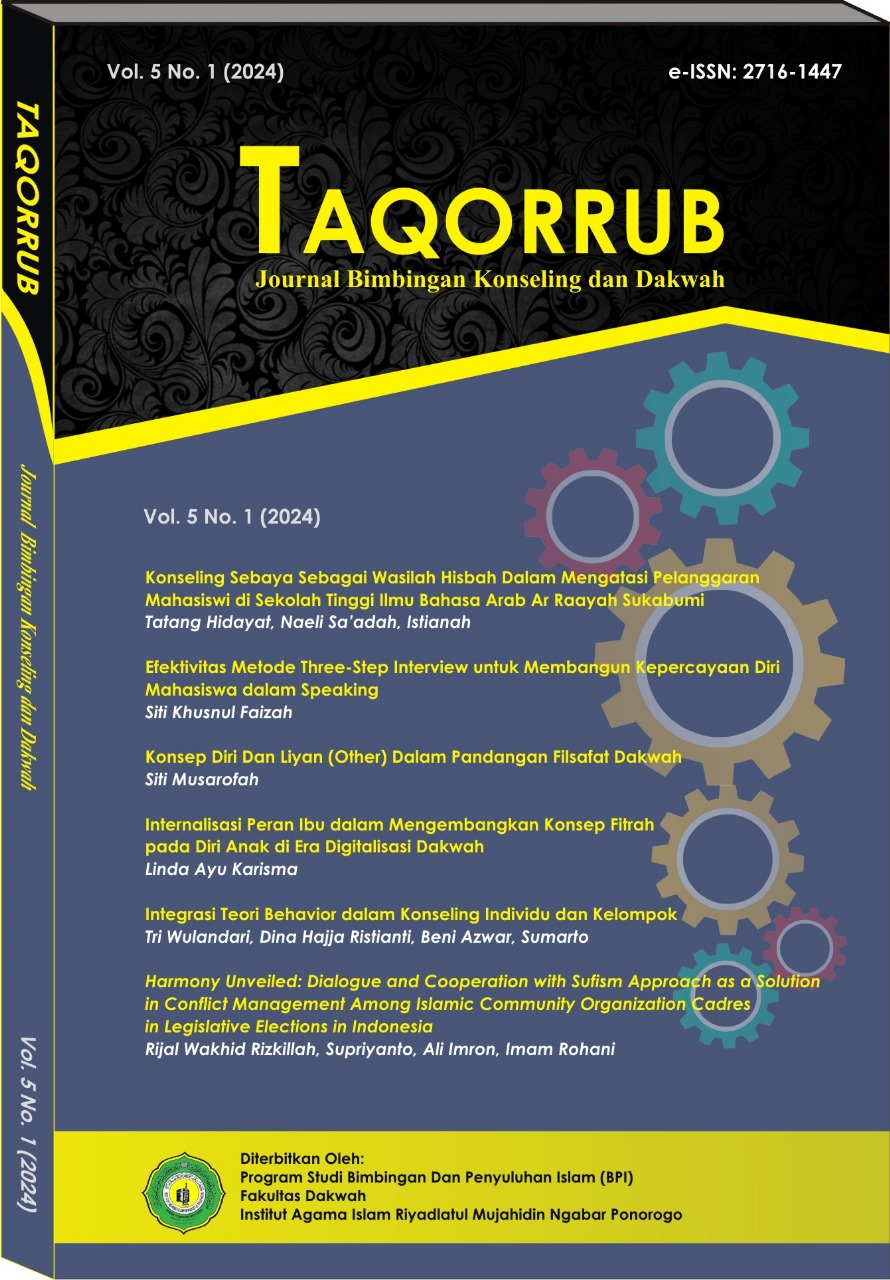
Efektivitas Metode Three-Step Interview untuk Membangun Kepercayaan Diri Mahasiswa dalam Speaking
DOI:
https://doi.org/10.55380/taqorrub.v5i01.825Keywords:
Speaking skill, Three-Step Interview, Direct Instruction, Self-confidenceAbstract
Abstract
This study aims to find out whether: (1) Three-Step Interview is more effective than Direct Instruction for teaching speaking, (2) Students who have high confidence have better speaking ability than students who have low confidence. This research was conducted at Institut Agama Islam Riyadlotul Mujahidin (IAIRM) Ngabar Ponorogo in the academic year 2023/2024. The population of this study were students of the Riyadlotul Mujahidin Islamic Institute (IAIRM) Ngabar Ponorogo. The sample of this study came from first semester students in the 2023/2024 academic year. The research method used is experimental research. The sample was taken using cluster random sampling. The research data were collected using questionnaires and speaking tests. The questionnaire was used to classify students into two groups, namely students who have high confidence and students who have low confidence. The speaking test was used to determine the ability of students' speaking skills. After normality and homogeneity tests were conducted, hypothesis testing was done. The speaking test data was analyzed using 2 x 2 analysis of variance and Tukey test.
Based on the data analysis, there are several research findings that can be drawn. First, the Three-Step Interview method is more effective than the Direct Instruction method in teaching speaking. Second, students who have high self-confidence have better speaking ability compared to students who have low self-confidence. The effectiveness of the teaching method is influenced by the students' confidence level. Based on the research findings, it can be concluded that the Three-Step Interview method is an effective method for teaching speaking to first semester students of the Riyadlotul Mujahidin Islamic Institute (IAIRM) Ngabar Ponorogo in the 2023/2024 academic year. Therefore, the use of Three-Step Interview is recommended in teaching speaking. To achieve good results, the basic elements and procedures of the Three-Step Interview must be well implemented in the teaching-learning process. Since there is an interaction between teaching methods (Three-Step Interview and Direct Instruction) and students' confidence in teaching speaking, the two methods can be used to complement each other in teaching speaking so that students with high confidence and students with low confidence can obtain optimal achievement in learning to speak. Optimal achievement in learning to speak.
References
Anita Lie. (2005). Cooperative Larning: Mempraktikkan Pembelajaran Kooperatif di Ruang-ruang Kelas. Jakarta: Grasindo.
Arends, Richard I. (2012). Learning to Teach Ninth Edition. New York: McGraw-Hill Companies.
Bailey, Kathleen M. (2005). Practical English Language Teaching Speaking. New York: The McGrawHill Companies.
Barkley, Elizabeth F. et al. (2005). Collaborative Learning Techniques. San Francisco: John Wiley and Sons, Inc.
Bennet, B and C Rolheiser. (2001). Beyond Monet: The Artful Sience of Intructional Integration. Toronto, Ontario: Bookation.
Brown, H. Douglas. (1994). Principle of Language Teaching and Learning. San Francisco: Practice Hall Regents.
Brown, H. Douglas. (2001). Teaching by Principle (An interactive Approach to language pedagogy). New York: Prentice Hall.
Brown, H. Douglas. (2004). Language Assessment Principle and Classroom Practice. New York: Longman.
Bygate, M. (1997). Speaking. New York: Oxford University Press. Byrne, Donn. 1997. Teaching Oral English. Harlow England: Longman Group.
Christensen, Larry and Johnson Burke. (2000). Educational Research Quantitative and Qualitative Approaches. USA: Allyn and Bacon.
Ghufron, M.Nur & Risnawati, Rini. (2012). Teori-Teori Psikologi. ed. Rose Kusumaningratri. Yogyakarta: Ar-Ruzz Media.
Gower, R., Philips, D., Walter, S. (1995). Teaching Practice. Oxford: Heineman. Gunter, Estes, Schwab. (2003). Instruction, a models approach, 4th edition,http://www.lifeisastorypro blem.org/lesson/mdl_dir_instr. Html
Harel, Y. (1992). Teacher talk in the Cooperative learning classroom. In C. Kessler (ed.), Cooperative Language Learning: A Teacher’s Resource Book. New York: Prentice Hall. 153-162
Kagan, Spencer., and Kagan, Miguel. (2009). Kagan Cooperative Learning. Kagan Publishing
Kayi, Hayriye. Teaching Speaking: Activities to Promote Speaking in a Second Language, The Internet TESL Journal, Vol. XII, No. 11, November 2006. http://iteslj.org/Articles/Kayi-Teaching Speaking.html.
L. Chaney and T. L. Burke. (1998). Teaching Oral Communication in Grades K-8. Boston: Allyn & Bacon.
Lauster, Peter. (2008). Tes Kepribadian. ed. D.H.Gulo. Jakarta: PT Bumi Aksara
Lawrence, Denis. (2006). Enhancing Self-Esteem in the Classroom Third Edition. London: Paul Chapman Publishing.
Rosenshine, Barak. (2008). Five Meanings of Direct Instruction. US: Center on Innovation & Improvement. In http://www.centerii.org/pdf.
Syam, A. (2017). Pengaruh Kepercayaan Diri (Self Confidence) Berbasis Kaderisasi Imm Terhadap Prestasi Belajar Mahasiswa (Studi Kasus Di Program Studi Pendidikan Biologi Fakultas Keguruan Dan Ilmu Pendidikan Universitas Muhammadiyah Parepare), 5, 87–102.
Tuchman, Bruce W. (1978). Conducting Educational Research. New York: Harcourt Brace Javanovich, inch.
Widdowson, H. G. (1996). Teaching Language as Communication. Hong Kong: Oxford University press.