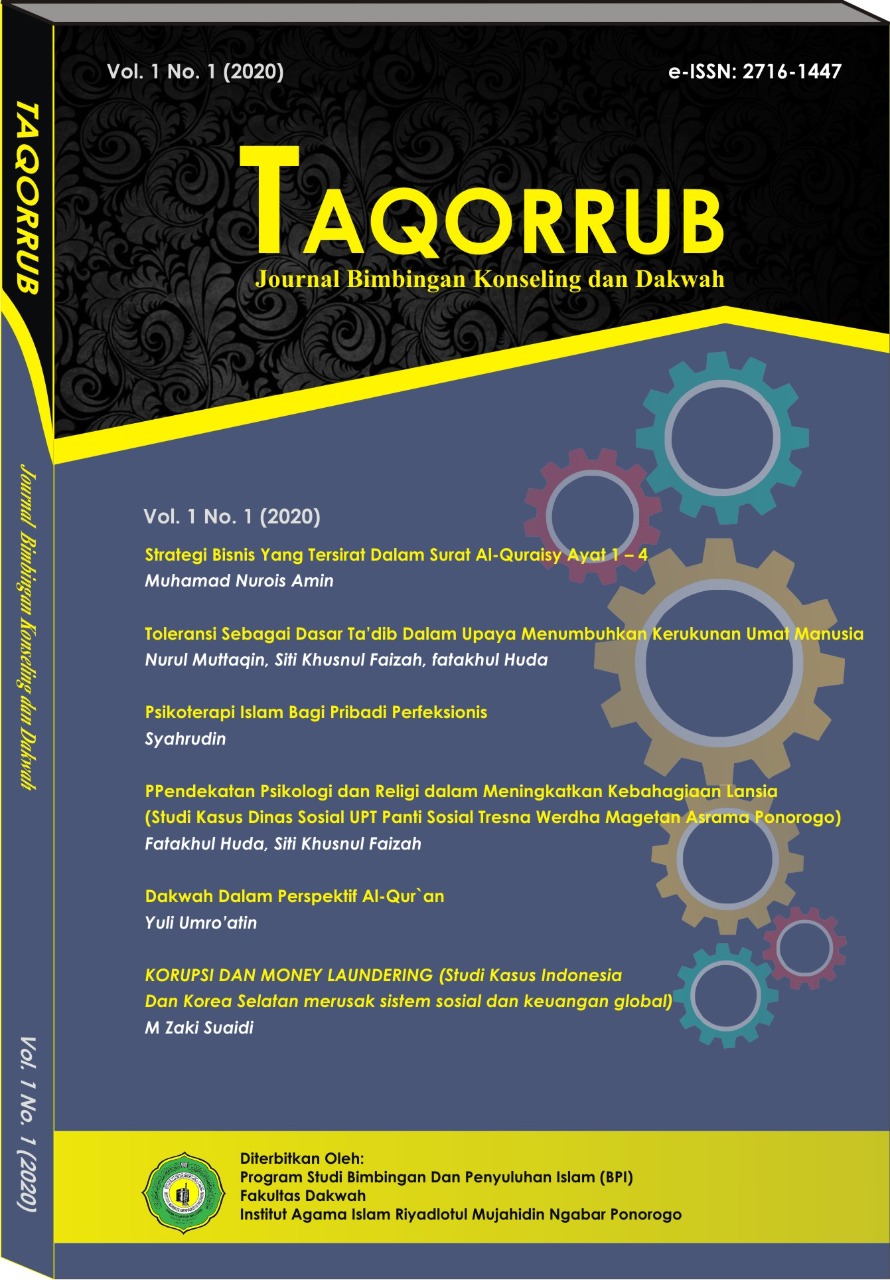
KORUPSI DAN MONEY LAUNDERING (Studi Kasus Indonesia Dan Korea Selatan merusak sistem sosial dan keuangan global)
DOI:
https://doi.org/10.55380/taqorrub.v1i1.143Keywords:
CORRUPTION, MONEY LAUNDERING, GLOBALIZATIONAbstract
Corruption in Indonesia and in other countries has become a latent problem and is very difficult to eradicate. Various attempts have been made to eradicate this corruption: both at the country level itself and at the international level. In general, the eradication of corruption is carried out through the establishment of a corruption eradication agency or institution which is legalized through a law. Furthermore, the following presentation is a case study of Indonesia and South Korea on how to eradicate corruption.
The practice of money laundering has often involved cross-border transactions, because by conducting such transactions between countries, it is very effective in eliminating traces of illegal flows of funds. With the increasing globalization of the international financial system, money laundering, as a criminal activity, is becoming more and more common, but in turn it greatly affects and damages the global social and financial system.
In summary, it can be concluded that in the era of globalization the problem of corruption and money laundering is becoming increasingly widespread because the existence of this crime involves many factors that cross national boundaries. The problem of corruption and money laundering is the dark side of globalization. Handling corruption and money laundering cannot be resolved quickly and easily, but it takes time, commitment, political will, and support from all parties: national government, society, and multilateral cooperation. Learning from South Korea, Indonesia and the international community, for example, requires a more efficient structure-based bureaucratic reform by upholding the spirit of 'Good Governance' and 'Check and Balance' which is expected to encourage all elements of the nation to work together to solve corruption at a practical level.
References
Budi Winarno. 2009. "Persaingan Negara dan Pasar: Mengkaji Peran Negara Dalam Era Globalisasi"
Catatan penulis mengungkapkan bahwa kelompok koruptor ini sudah menjadi gurita yang sangat ganas dan mengerikan, sekaligus mampu mencabik-cabik dan kalau perlu mematikan negara, serta menyengsarakan rakyat
Deni Setyawati, 2008. KPK: Pemburu Koruptor, Yogyakarta: Pustaka Timur. Budiarto Shambazy, "Korupsi Meja," Kompas 4 Juni 2011.
Eddy Ahimsha-Putra, 2002."Korupsi di Indonesia: Budaya atau Politik Pemaknaan?" Jurnal Wacana, Edisi14 Tahun III 2002.
George Junus Aditjandra, 2002. "Bukan Persoalan Telur dan Ayam: Membangun Kerangka yang lebih
Holistikbag; Gerakan Anti Korupsi di Indonesia,"Jurnal Wacana, Edisi 14 Tahun III. M
Jan Van Dijk, 2011. The Faces of Victimhood: Globalization, Transnational Crimes and Victim Rights, London: Springer, hal. 109.
Joseph S. Nye, 1967."Corruption and Political Development: A Cost-Benefit Analysis,"Amer/can Political
Kamus Besar Bahasa Indonesia, Pusat Bahasa Departmen Pendidikan Nas'ional, Jakarta, 2008 '
Mohtar Mas'oed, 1994. Politik. Birokrasi dan Pembangunan, Yogyakarta: Pustaka Pelajar. " Budi Winarnc. 2008. Globalisasi peluang atau ancaman bagi Indonesia. Jakarta: Erlangga. Hal 68 " Santoso (1993:57) dalam Budi Winarno (2008). Globalisasi: Peluang atau Ancaman bagi Indonesia. Jakarta: Erlangga.
N. Gwynne dan Christobal Kay, 2004. Latin America Transformed: Globalization and Modernity, New York:
Peter Reuter dan Edwin M. Truman, 2004. Chasing Dirty Money: The Fight Against Money Laundering, Washington:The Institute for International Economics, hal 1.
Phil Williams, 2001 .Transnational Crime and Corruption," dalam Brian White, et.al, (eds.). Issues in World Politics, Second Edition, New York: Palgrave,
Pidato Michael Camdessus yang berjudul "Money Laundering: the Importance of International Countermeasures,"pada Plenary Meeting ofthe Financial Action TaskForccon Money Laundering di Paris pada 10Feruari 1998, diakses dari httpV/www.imf.org/external/np/speeches/1998/021098.htm pad 24 Juni 2011.
Rebecca M.Wallace, 1986. International Law, London: Sweet & Maxwell Limited
Samuel P. Huntington, 1968. Political Order in Changing Societies, New Haven: Yale University,
Sarah Bracking (ed.), 2003. Corruption and Development: The Anti-Corruption Campaigns, University of
Science Review, Vol. 61, No. 2, hal. 417-427. " Farid R. Fakif. 2003."Mendulang Rente di Sekitar lstana,"7urno/ Wacana, Edisi 14Tahun III.
Sorcha Macleod and Douglas Lewis, 200-1, * Transnational Corporations : Power, Influence, and Responsibility," Global Social Policy, Vol 4 (1) dalam Budi Winarno, Giobalisasi dan Krisis Demokrasi, Yogyakarta: MedPress, 2007.
Syed Hussein Alatas, 1999. Corruption and the Destiny of Asia, Kuala Lumpur: Prentice Hall,
Teddy Lesmana, Peneliti pada Pusat Penelitian Ekonomi LIPI-Jakarta, dimuat di Harian Batam Pes 14 April 2007
Tindak Pidana Pencucian Uang (Money Laundering), diakses dari http://www.jdih.bpk.go.id/ informsihukum/Money I aundering.pdf. pada 25 Juni 2011.
United Nations Convention Against Illicit Traffic in Narcotic, Drugs and Psychotropic Substances of 1988, diakses dari http://www.unodc.org/pdf/convention 1988 en.pdf pada 26 Juni 2011.