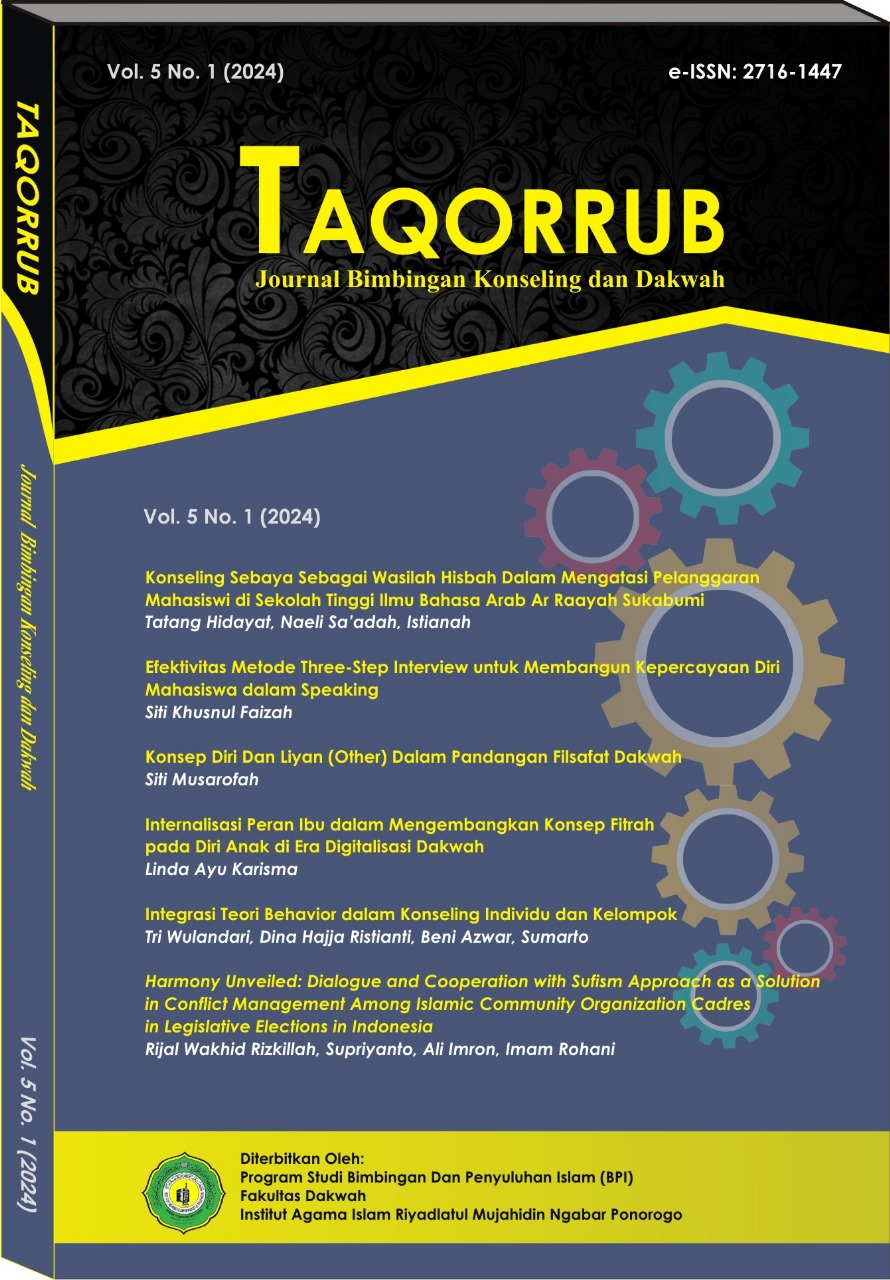
Implementation of Da'wah Values in Islamic Education Learning at SMPN 5 Margorejo, Lampung
DOI:
https://doi.org/10.55380/taqorrub.v5i01.1168Keywords:
Implementation, Da'wah Values, Islamic Education, Digital Era, SMPN 5 Margorejo LampungAbstract
This study aims to describe the implementation of da'wah values in Islamic Education learning in the digital era at SMPN 5 Margorejo, Lampung. The development of information technology has had a significant influence on learning methods, media, and approaches, including in the delivery of da'wah values. Islamic Religious Education (PAI) teachers are required to be able to integrate da'wah principles such as amar ma'ruf, nahi munkar, and the formation of noble morals into teaching and learning activities by utilizing digital technology. This study uses a qualitative approach with a field study method through observation, interviews, and documentation. The results of the study indicate that the implementation of da'wah values is carried out through three main aspects, namely: (1) the use of digital media such as learning applications and communication platforms as a means of conveying da'wah messages, (2) the integration of da'wah materials in the PAI curriculum contextually with student needs, and (3) the development of students' religious character through strengthening religious practices in schools. The main obstacles faced include limited access to technology for some students and teachers' skills in utilizing digital media. This study concludes that digital-based da'wah education at SMPN 5 Margorejo, Lampung, has the potential to be an effective strategy in strengthening religious values while simultaneously developing students' digital literacy.
References
Arifin, Syamsul, Moh Anas Kholis, and Nada Oktavia. “Tantangan Dan Peluang Integrasi Pendidikan Agama Islam Dalam Konteks Kurikulum Merdeka Di Sekolah Dasar.” NUR EL-ISLAM : Jurnal Pendidikan Dan Sosial Keagamaan 8, no. 2 (2022): 147–83. https://doi.org/10.51311/nuris.v8i2.372.
Creswell, J. W. Research Design: Qualitative, Quantitative, and Mixed Methods Approaches. Thousand Oaks: CA: SAGE Publications, 2018.
Fita Mustafida. “Integrasi Nilai-Nilai Multikultural Dalam Pembelajaran Pendidikan Agama Islam (PAI).” Jurnal Pendidikan Islam Indonesia 4, no. 2 (2020): 173–85. https://doi.org/10.35316/jpii.v4i2.191.
Herdiyanti, Yuni, Miftakul Janah, and Roni Susanto. “Building a Golden Generation : Synergy of Education , Technology , and Qur ’ Anic Values.” JISEI: Journal of Islamic Studies and Educational Innovation 01, no. 01 (2025): 36–48.
Hsiao, Peng Wei, and Chung Ho Su. “A Study on the Impact of Steam Education for Sustainable Development Courses and Its Effects on Student Motivation and Learning.” Sustainability (Switzerland) 13, no. 7 (2021): 1–24. https://doi.org/10.3390/su13073772.
Huberman, A. Michael, and Saldana Jhonny. Qualitative Data Analysis a Methods Sourcebook. America: Arizona State University, 2014.
Indrawan, I Putu Oktap, I Gede Sudirgayasa, and I Komang Wisnu Budi Wijaya. “Integrasi Kearifan Lokal Bali Di Dunia Pendidikan.” Prosiding Seminar Nasional Webinar Nasional Universitas Mahasaraswati Denpasar “Percepatan Penanganan COVID-19 Berbasis Adat Di Indonesia,” no. 3 (2020): 189–94.
Isti’ana, Ais. “Integrasi Teknologi Dalam Pembelajaran Pendidikan Islam.” Indonesian Research Journal on Education 4, no. 1 (2024): 302–10. https://doi.org/10.31004/irje.v4i1.493.
Khomsinuddin, Giman Bagus Pangeran, Ahmad Tamyiz, Citra Eka Wulandari, and Fauzan Akmal Firdaus. “Modernitas Dan Lokalitas: Membangun Pendidikan Islam Berkelanjutan.” Journal of Education Research 5, no. 4 (2024): 4418–28. https://jer.or.id/index.php/jer/article/view/1523.
Nizar, Samsul. Filsafat Pendidikan Islam Dalam Perspektif Pemikiran Islam Klasik Dan Modern. Jakarta: Kencana, 2020.
Rizqi, Chabaibur Rochmanir, and Nicky Estu Putu Muchtar. “Akulturasi Seni Dan Budaya Walisongo Dalam Mengislamkan Tanah Jawa.” Studia Religia : Jurnal Pemikiran Dan Pendidikan Islam 7, no. 2 (2023): 193–201. https://doi.org/10.30651/sr.v7i2.20526.
Roni Susanto, Fatakhul Huda. “Education as an Agent of Social Change: A Sociological Persfective.” Taqorrub: Jurnal Bimbingan Konseling Dan Dakwah 5, no. 2 (2024): 79–94. https://scholar.google.com/scholar?oi=bibs&cluster=16197885558079716437&btnI=1&hl=id.
Sugiyono. Metode Penelitian : Kuantitatif, Kualitatif, Dan R&D. Bandung: CV Alfabeta, 2016.
———. Metode Penelitian Pendidikan. Bandung: CV Alfabeta, 2010.
Supriyanti, Dewi Kurniawati, and Roni Susanto. “Analysis of the Minister of Education ’ s Curriculum Policy in the 2019-2024 Vs . 2024-2029 Era.” QALAMUNA: Jurnal Pendidikan, Sosial, Dan Agama 17, no. 1 (2025): 741–54. https://doi.org/10.37680/qalamuna.v17i1.7127.
Susanto, Roni. “Konsep Pendidikan Karakter Dalam Islam.” In Pendidikan Karakter Berbasis Islam, 20–32. U ME Publishing, 2024.
Susanto, Roni, M Makhrus Ali, and Martoyo Deden Hidayat. “Islamic Religious Education in the Independent Learning Curriculum.” IKTIFAK : Journal of Child and Gender Studies 02, no. 02 (2024): 63–72. https://doi.org/https://doi.org/10.55380/iktifak.v2i2.962.
Wahyudi, Ahmad, Alif Qurrotin Nuriana, and Muhammad Irfan. “Cultural Adaptation in Islamic Education : Navigating Between Tradition and Modernity.” JISEI: Journal of Islamic Studies and Educational Innovation 01, no. 01 (2025): 101–14.